
Dr Rachel Morris
Your best people aren’t burning out because they’re weak.
They’re burning out because they’ve been conditioned to take responsibility for everyone and everything – and no one’s shown them how to put it down.
Keynote speaker • Executive coach • Host of the You Are Not a Frog podcast (1M+ downloads, Apple Top 100 UK Business Chart)

“Rachel’s keynote was outstanding. She was engaging, authentic and energetic, combining real authority with warmth, humour and a genuine passion for helping people understand wellbeing, burnout and thriving at work. She communicated important and complex themes in a way that felt practical, human and memorable.”
— Dr Richard Duggins, Author of ‘Burnout Free Working’, Consultant Psychiatrist and Associate Medical Director
Your most capable, most conscientious people are running on empty. They take responsibility for everything – outcomes they don’t control, problems nobody quite owns, their team’s emotional load – and they can’t put any of it down without feeling like they’re failing.
Then they burn out, disengage, or leave. And it costs you the people you can least afford to lose.
Most organisations respond with wellbeing programmes and resilience training. But for doctors and other high performers in high-stakes roles, that advice doesn’t just fall short – it can make things worse. Many self-care strategies add more onto their already full to-do lists – they know what they need to do, but don’t have the time to do it.
Because the problem was never time management. It’s the Responsibility Trap – the way high achievers have been conditioned to automatically pick up responsibility for everything, even what isn’t theirs to carry. And until you address that, no amount of wellbeing will move the needle. Wellbeing is an outcome, not an intervention.
I identify the patterns of people pleasing and perfectionism driving overwork in professionals in high stress, high stakes roles, and help them to stop amplifying their own overwhelm, protect their time, and lighten the load – without waiting for the system, the workload, or anything else to change. So they can carry less, achieve more – and we can stop losing our best people to burnout.
“Enabled greater stability and consistent performance during a period of major organisational change.”
— Matthew Walker, Publishing Director, International Education, Cambridge University Press & Assessment
Why Me?
I spent 20 years as an NHS GP, working on the frontline in a system that demands everything and gives few choices about how you work. Over the past decade – and through hundreds of deep-dive conversations on my podcast – I’ve uncovered what’s really driving burnout in high-stakes professionals. It isn’t that they don’t know how to look after themselves. It’s that they’ve been trained to pick up responsibility automatically, and putting it down feels like failure, especially when the stakes are high and the consequences are real.
I’ve now helped thousands of doctors and senior leaders break out of that pattern – so they can care deeply without feeling responsible for everything.
These tools were built and stress-tested in medicine, where the cost of getting a boundary wrong is as high as it gets – which is exactly why they work just as well in any high-pressure organisation.
Credentials and experience:
Medical Doctor and former NHS GP (1998–2020) – Faculty, University of Cambridge School of Clinical Medicine for 15+ years – set up and led the Professionalism Course; Assistant Director of GP Studies – Author and co-presenter of Red Whale’s Lead, Manage, Thrive! — a national leadership course delivered to thousands of GPs and practice managers – Executive and team coach; creator of the Shapes Toolkit® resilience training programme – Host of You Are Not a Frog — 1M+ downloads, 300+ Episodes, Apple Top 100 UK Business Chart

The Talks
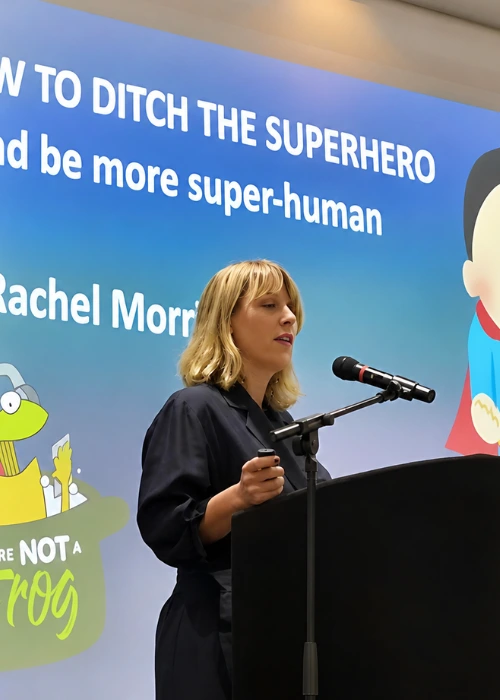
How to Ditch the Superhero and Be More Superhuman (signature keynote)
Why do the most capable, committed people burn out – while the advice meant to help them barely touches it?
In this keynote, Rachel reframes burnout entirely. It isn’t a sign of weakness or a skills gap. It’s the Responsibility Trap – the conditioned habit of carrying responsibility for everything, including what’s outside your control. Drawing on 20 years on the frontline in the NHS, and her own story of building a resilience business and still falling into the trap, Rachel shows audiences why the usual wellbeing advice fails high performers, how to recognise the hidden patterns that amplify their overwhelm, and how to care deeply about their work without carrying all of it.
Crucially, this isn’t only about preventing burnout. When people stop carrying what was never theirs, they do fewer things, better – and have more impact. And it works without waiting for the system, the workload, or anyone else to change first.
Audiences leave lighter, clearer, relieved they’re not failing – and with permission to delegate without guilt, have the conversations they’ve been avoiding, and protect the capacity that keeps their best people from walking out.
Ideal for: leadership conferences, all-staff events, and away-days in high-stakes, high-performance sectors.
“Rachel has a fantastic ability to connect with her audience, balancing excellent content with an engaging delivery style that keeps participants involved throughout. Our delegates consistently give outstanding feedback following her sessions. If you are looking for a speaker who can engage an audience while delivering meaningful, high-quality leadership content, Rachel is superb.”
— Ben Falk Director Of Operations at Guy’s and St Thomas’ NHS Foundation Trust
Everyone Needs a Hero? How to Lead Without Rescuing
The instinct that makes someone a great professional – stepping in, fixing it, carrying the load – is the same instinct that burns out conscientious leaders and managers and stops their teams from growing. This talk shows leaders how to move from rescuer to coach: how to support their people without absorbing their responsibility, give honest feedback without guilt, and build teams that take ownership rather than waiting to be saved.
Ideal for: managers, senior leadership away days, and leadership development programmes.
The Talks
How to Ditch the Superhero and Be More Superhuman (signature keynote)
Why do the most capable, committed people burn out – while the advice meant to help them barely touches it?
In this keynote, Rachel reframes burnout entirely. It isn’t a sign of weakness or a skills gap. It’s the Responsibility Trap – the conditioned habit of carrying responsibility for everything, including what’s outside your control. Drawing on 20 years on the frontline in the NHS, and her own story of building a resilience business and still falling into the trap, Rachel shows audiences why the usual wellbeing advice fails high performers, how to recognise the hidden patterns that amplify their overwhelm, and how to care deeply about their work without carrying all of it.
Crucially, this isn’t only about preventing burnout. When people stop carrying what was never theirs, they do fewer things better – and have more impact. And it works without waiting for the system, the workload, or anyone else to change first.
Audiences leave lighter, clearer, relieved they’re not failing – and with permission to delegate without guilt, have the conversations they’ve been avoiding, and protect the capacity that keeps their best people from walking out.
Ideal for: leadership conferences, all-staff events, and away-days in high-stakes, high-performance sectors.
Everyone Needs a Hero? How to Lead Without Rescuing
The instinct that makes someone a great professional – stepping in, fixing it, carrying the load – is the same instinct that burns out conscientious leaders and managers and stops their teams from growing. This talk shows leaders how to move from rescuer to coach: how to support their people without absorbing their responsibility, give honest feedback without guilt, and build teams that take ownership rather than waiting to be saved.
Ideal for: managers, senior leadership away days, and leadership development programmes.
How to Beat Burnout in Challenging Times
When you’re asked to do more with less – shrinking resources, rising expectations, the pressure of constant change – the standard wellbeing playbook doesn’t work. This talk is about staying in your performance zone when the heat is genuinely rising: protecting your time, managing your energy, and embracing the fact that you’re finite, so you can keep performing sustainably rather than borrowing against your health, your relationships, and your future.
Ideal for: organisations going through change, restructure, or sustained pressure.
How to Say No, Set Boundaries and Deal with Pushback
Most people know what their boundaries should be. What stops them is the consequences – the guilt, the awkwardness, the fear of letting someone down. This practical, tool-rich talk tackles the real obstacle: how to say a clear no without damaging relationships, hold a boundary when it crumbles under pressure, and recognise that pushback usually means your boundary is working.
Ideal for: team workshops, professional development sessions, and audiences who want practical takeaways they can use on Monday morning.
“Rachel is a lively and engaging speaker — funny, relatable and deeply thought-provoking. She brings a real personal touch to her talks, combining humour with poignant reflections that really land. She kept the audience captivated throughout and left people feeling inspired to make meaningful changes.”
Dr Caroline Bailey, GP & Study Day Organiser
Who I've Worked With

I’ve spoken and trained across sectors where the work genuinely matters, and the pressure is real – including healthcare, law, pharmaceuticals, technology, publishing, education and veterinary medicine. I have chaired panels, hosted live podcast recordings at events, and delivered keynotes and in-depth training to audiences from intimate leadership groups to several hundred professionals.
“Before, my workload was overwhelming — I was close to walking away. Now I’ve saved a full day a week through better delegation and mentoring, work more efficiently, and genuinely love my job again.”
Senior Healthcare Leader
If your wellbeing programmes aren’t working, the problem might be deeper than wellbeing.
Let’s talk about what your people are really carrying – and how to help them put it down.
Follow the podcast


